Thursday, July 3, 2008

145th History Carnival

Today I took my 11 year old daughter to Gettysburg to soak up the 145th anniversary of the Battle of Gettysburg [Before I continue: she went willingly and she had a good time!]. Anyway, I consider Gettysburg in early July to be a history carnival, since the town is abuzz with reenactors, encampments, book signings, and Park Service battle walks. Like a carnival it gets crowded, but for me that is part of the appeal. As evidence of the crowd, my daughter and I played the license plate game and we witnessed 35 state and 2 Canadian province license plates. I'm sure if we really tried we could have found all 50 states.

Our first stop, after driving through two parking lots to find a spot to park (and license plates, of course), was the new Visitor's Center. This is a first class facility. We first went to the gift shop which has more souvenirs than the old Visitor's Center. I tried not to spend too much time in the book section, which could get boring for an 11 year old to wait for history nerd Dad to skim through several dozen books, so we moved on to the amazing lollipops (she got a watermelon and I got a peanut butter and jelly). We then went to the exhibits. We watched the three short movies dealing with each day at Gettysburg and tried our hand at a couple of the interactives. Before we left the exhibits we went into the Gettysburg Address room and listened to a rendition of the Address while reading it on an etching on a glazed window.


By this time we were getting hungry so we made our way to parking lot 3, and proceeded to General Pickett's Buffet. We then worked off lunch by walking into town. We stopped at some souvenir shops and at the Greystone American History Store (my favorite in Gettysburg). On the way back to the car we walked through the National Cemetery. We were going to go on a battle walk in the Cemetary, but the crowd was too big and we were getting tired so we made our way back to the car. I think it's important to visit the National Cemetery. It makes Lincoln's words in the Gettysburg Address more immediate by actually seeing the graves of the men who brought Lincoln to Gettysburg in the first place. We read some of the names from the soldiers graves and then walked through the hundreds of unknown graves. Those soldiers may be unknown to us today, but they were all known and missed by loved ones 145 years ago. Just a thought to put our lives into perspective (which is what Lincoln wanted us to do).


Before heading home we made a detour to the Cashtown Inn. Since my daughter is interested in ghost stories I thought the Cashtown Inn would be the perfect stop since it is allegedly haunted. It was also a building that witnessed most of the Army of Northern Virginia pass by in the days before, during, and after the battle. We couldn't go inside so we took in the views from outside and imagined what it would have been like to be there 145 years ago.

We then went home after spending a fun day at Gettysburg. The day was relatively light on battle history but it was successful because my daughter wants to return for an overnight visit. Plus, the kicker is we just got done watching the 1st part of the movie Gettysburg. I think I may be making a mini-me, history nerd out of my daughter. Scary thought...

Saturday, June 28, 2008

Brain Rules: Now what?


My thoughts after reading the book:


"The brain is a sequential processor, unable to pay attention to two things at the same time. Businesses and schools praise multitasking, but research clearly shows that it reduces productivity and increases mistakes."
On one level this seems obvious, but on another level it seems somewhat surprising. It seems obvious that students passing notes or texting in class are not as productive and more likely to make careless mistakes, or miss important information, than students who are focused and on task. They may be the same students who ask a question that was just answered, or who failed to complete an important task on an assignment. However, don't we all multitask without any noticeably negative effects on our performance much of the time? Aren't effective teachers effective multitaskers? Should we be teaching students to be multitaskers, or should we be teaching students how to cut through distractions and focus on one task at a time? Or should we be doing both? When is it appropriate to multitask in class and when should students focus on one task at a time? One rule that makes sense to me is that when the teacher or another student is addressing the class, all attention should be focused on the speaker. That means if students are working on laptops, then the laptops must be down. When the speaker is done, the laptops may go up. I know this is something that I will need to work on in meetings. What do you think?

"Emotionally erousing events tend to be better remembered than neutral events."
This, too, seems obvious. The question is how do we stimulate student emotions in order to maximize learning? Here are two of my ideas:

  • Select visually stimulating resources. This is actually related to Brain Rule #10 "Vision trumps all other senses." I find video clips from movies and youtube can spark emotions that lead to increased interest from students better than boring documentaries and slide show-like video clips and PowerPoint presentations. Also, pictures like these are an effective way to get students thinking and engaged.
  • Don't avoid controversies. Encourage students to discuss and debate controversial issues as a way to process the emotions, in order to lead to a greater understanding of the context and issues related to the controversy. Challenging students way of thinking by playing devil's advocate can be an intellectually and emotionally stimulating endeavor for students as they come to grips with why they believe what they believe. This will lead to either a strengthened conviction in their original viewpoint, or a shifting of their thinking due to a logical argument. Regardless, it was the emotion that the controversy evoked that hooked the student in the first place. An example of how this could work in a history classroom could be prior to studying abolitionist John Brown's exploits students could be shown a video clip about a death penalty case and be asked to decide their views on capital punishment. After learning about John Brown and his hanging students could be asked if their original view on capital punishment has changed. How about if you personally knew someone who was a victim? John Brown and capital punishment can be jumping off points to investigate topics like revenge, mercy, and forgiveness. Students can then be instructed to find examples of each in history and today.

I have other thoughts about Brain Rules, but it is getting quite late. The main question is that if we know these things to be true, how does it impact how we teach? What things are we doing that brain research confirms are effective, and what are we doing that could be done more effectively?

Friday, June 20, 2008

Memories-What students remember

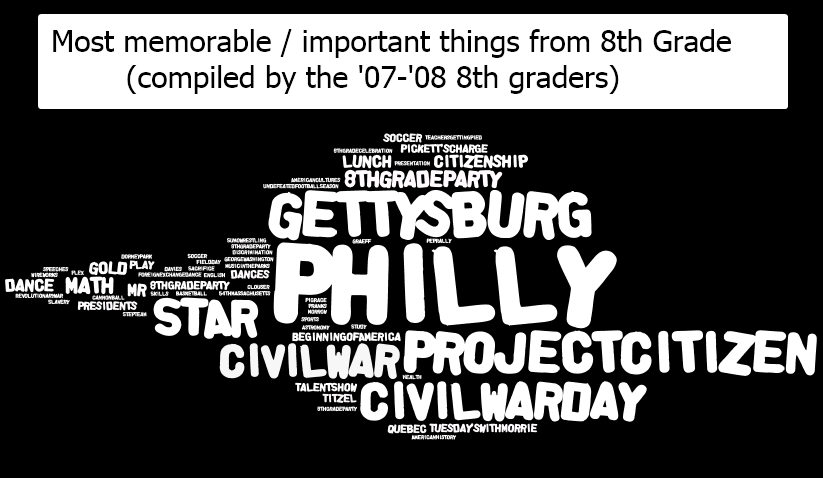
On one of the last days of school I asked students to write down their most memorable moments and most important things they learned this school year. I combined the list and made a word cloud out of their responses (I know this may be wordle overkill but I'm on a roll). I took out memorable responses that had to deal with me embarrassing myself in class, which, unfortunately for me, happens all too often.


I am pleased, and not surprised, to see the two field trips (Philadelphia and Gettysburg) are two of the most common responses. I would love to teach history without ever stepping into a classroom. The best way to teach history is to go [cliche alert] where history took place and walk in the footsteps of those who went before us. Instead of just watching videos, looking at maps, and discussing Pickett's Charge, why not actually walk the field where the 12,000 Confederate soldiers walked on July 3rd, 1863. Or instead of reading about our founding fathers (and mothers) why not sit in the actual pew where they worshiped (where many of our students did at Christ Church in Philadelphia). History can be experienced and true learning can be enhanced if we just know where to go. It is sad to think that schools have eliminated educational field trips due to budgetary constraints. We have a Civil War day, which is great, but it doesn't come close to the experience of actually being where history was made. On my family's way to the Poconos for vacation we made our obligatory history stop. I decided to take my family into a mine. What better way to teach my children to appreciate the things they have and the life they live. The 40 minutes we spent inside that mountain will be remembered by my girls for the rest of their lives. I believe that the field trips my students took to Philadelphia and Gettysburg will be remember for the rest of their lives, as well. Will they remember all the details? No. Will they have an increased interest to learn more about our history? I believe so!

Another large response was Project Citizen. Students had to learn about public policy so they could determine a problem in the community that was a public policy issue. The students worked collaboratively researching a local problem. A large part of the research was to interview experts and to seek out information from reliable sources. The students then broke into 4 groups to prepare a presentation on the Problem, Alternate Solutions, the Proposed Policy, and an Action Plan. Each group had subcommittees working on a wiki, display board, information binder, and a speaker. The key to the whole experience was the presentation to real local policymakers. The students pitched their policy proposal to a School Board member and two Township Supervisors. The real life nature of the project is what made it so memorable.

How else can we make our learning experiences for students real life?

Tuesday, June 17, 2008

My internet habits exposed

As I've been recently reading through some education blogs (Coolcatteacher, Practical Theory, Weblogg-ed) I've discovered Wordle. It's a website that creates word clouds from almost anything. For example, copy and paste the Gettysburg Address and the most frequently used words show up larger and bolder. The really cool thing is that you can create tag clouds from your Del.icio.us tags. Here is mine (screen captured using Jing).

I will be comparing my Del.icio.us tag clouds from time to time to see how my tagging (and web browsing habits) change over time.

In what ways is Wordle relevant for the classroom? Can word clouds help students improve reading comprehension? or gain a greater understanding of a historic document or speech? or help students see relationships between two historic documents or speeches?

What other thoughts or ideas do you have?

Monday, May 26, 2008

Skills, not content

When reflecting on what was learned this year it is my hope that students consider the non-content related things they may have learned. My last post was dedicated to the content that was taught, but that is only part of what I was trying to teach this year. How about skills? Not the type of skills that Napoleon Dynamite was referring to, but real skills that will help students be successful citizens and students. Here is an outline of the most important skills we worked on:

technology

  1. wikis (American Revolution project, Project Citizen wikis, Wikipedia)
  2. blogs (Class Scribe, Debate This!, Final Project)
  3. Google (Gmail, Reader, News, Groups, Blogger)
  4. Delicious--social bookmarking
  5. Animoto

Be able to apply these resources to real learning by communicating and collaborating more effectively

Citizenship

  1. researching local issues
  2. identifying local officials
  3. preparing presentation (binder, poster board, wiki)
  4. public presentation to public officials

Understand that you have a role to play as a citizen, and how to effectively play that role

Writing and Thinking

  1. Summarizing (Cornell Note taking Method, gist statement, mini-saga)
  2. Supporting a point of view (Moodle Discussion forums, Blog comments, Debate This! posts)
  3. Challenging a point of view
  4. Cause and Effect (unintended consequences of public policies, Causes of Civil War)

Be able to make sense of the world around you by understanding information presented to you in written and oral form