Showing posts with label reflection. Show all posts

Friday, June 20, 2008

Memories-What students remember

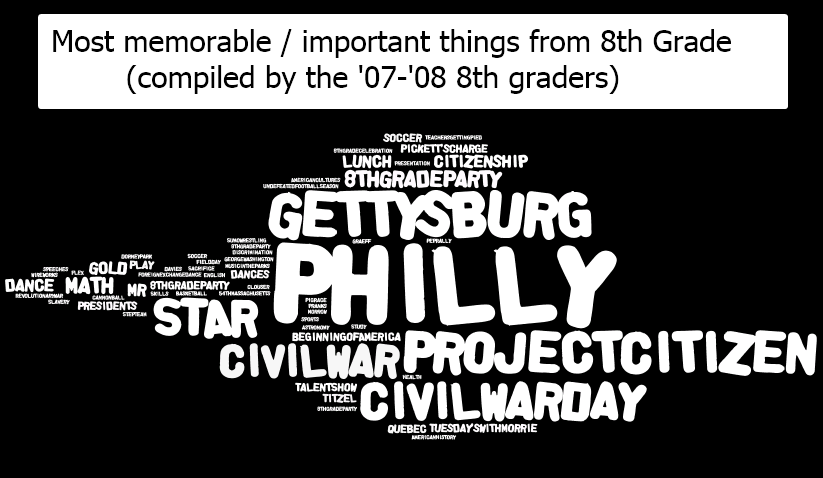
On one of the last days of school I asked students to write down their most memorable moments and most important things they learned this school year. I combined the list and made a word cloud out of their responses (I know this may be wordle overkill but I'm on a roll). I took out memorable responses that had to deal with me embarrassing myself in class, which, unfortunately for me, happens all too often.


I am pleased, and not surprised, to see the two field trips (Philadelphia and Gettysburg) are two of the most common responses. I would love to teach history without ever stepping into a classroom. The best way to teach history is to go [cliche alert] where history took place and walk in the footsteps of those who went before us. Instead of just watching videos, looking at maps, and discussing Pickett's Charge, why not actually walk the field where the 12,000 Confederate soldiers walked on July 3rd, 1863. Or instead of reading about our founding fathers (and mothers) why not sit in the actual pew where they worshiped (where many of our students did at Christ Church in Philadelphia). History can be experienced and true learning can be enhanced if we just know where to go. It is sad to think that schools have eliminated educational field trips due to budgetary constraints. We have a Civil War day, which is great, but it doesn't come close to the experience of actually being where history was made. On my family's way to the Poconos for vacation we made our obligatory history stop. I decided to take my family into a mine. What better way to teach my children to appreciate the things they have and the life they live. The 40 minutes we spent inside that mountain will be remembered by my girls for the rest of their lives. I believe that the field trips my students took to Philadelphia and Gettysburg will be remember for the rest of their lives, as well. Will they remember all the details? No. Will they have an increased interest to learn more about our history? I believe so!

Another large response was Project Citizen. Students had to learn about public policy so they could determine a problem in the community that was a public policy issue. The students worked collaboratively researching a local problem. A large part of the research was to interview experts and to seek out information from reliable sources. The students then broke into 4 groups to prepare a presentation on the Problem, Alternate Solutions, the Proposed Policy, and an Action Plan. Each group had subcommittees working on a wiki, display board, information binder, and a speaker. The key to the whole experience was the presentation to real local policymakers. The students pitched their policy proposal to a School Board member and two Township Supervisors. The real life nature of the project is what made it so memorable.

How else can we make our learning experiences for students real life?

Monday, May 26, 2008

Skills, not content

When reflecting on what was learned this year it is my hope that students consider the non-content related things they may have learned. My last post was dedicated to the content that was taught, but that is only part of what I was trying to teach this year. How about skills? Not the type of skills that Napoleon Dynamite was referring to, but real skills that will help students be successful citizens and students. Here is an outline of the most important skills we worked on:

technology

  1. wikis (American Revolution project, Project Citizen wikis, Wikipedia)
  2. blogs (Class Scribe, Debate This!, Final Project)
  3. Google (Gmail, Reader, News, Groups, Blogger)
  4. Delicious--social bookmarking
  5. Animoto

Be able to apply these resources to real learning by communicating and collaborating more effectively

Citizenship

  1. researching local issues
  2. identifying local officials
  3. preparing presentation (binder, poster board, wiki)
  4. public presentation to public officials

Understand that you have a role to play as a citizen, and how to effectively play that role

Writing and Thinking

  1. Summarizing (Cornell Note taking Method, gist statement, mini-saga)
  2. Supporting a point of view (Moodle Discussion forums, Blog comments, Debate This! posts)
  3. Challenging a point of view
  4. Cause and Effect (unintended consequences of public policies, Causes of Civil War)

Be able to make sense of the world around you by understanding information presented to you in written and oral form

Wednesday, May 21, 2008

American Cultures Word Cloud

Here is a tag cloud I created based on some of the topics we studied in class this year. This is not a comprehensive list, but it is a good place to start a reflection on what we learned this year. The larger and bolder the term indicates that more emphasis was placed on it during the year. The Gettysburg Address is at the beginning and end of the tag cloud, since it was the theme for the year.