Showing posts with label Constitution. Show all posts

Sunday, November 29, 2009

The Constitution--Simplified

Constitution Video, Part 1 from Mr. Titzel on Vimeo.


Constitution Video, Part 2 from Mr. Titzel on Vimeo.


Making of the Constitution Video from Mr. Titzel on Vimeo.


Simplifying complicated concepts is an essential communication skill. With the advent of cheap video cameras, like the FlipCam that we use in class, and video hosting sites like YouTube and Vimeo, a whole new way of communicating is within reach of the masses. This new reality is changing what literacy means in the 21st century. To be fully literate in this new reality is to be able to use an interplay of images, music, and words to not only explain things in a new way but to also construct new meaning out of old knowledge. The ability to create these new mashups of media has become the new way to communicate in an age of accessible media hosting and creation tools.

The ability to master the creation of a media mashup in the current age of media saturation is equivilent to mastering the well crafted letter or written essay in the not so distant past. The importance of communicating through the written word is still essential; however, when the well crafted phrase is combined with an appropriate image and music the idea being communicated has gone from black and white to technicolor. The reality is more people will understand and be effected by the media mashup because it appeals to more of our senses and a greater portion of our brains than just reading words on a page or screen.

So, why don’t we all challenge ourselves to think about how we can change how we do school. Instead of thinking of that written essay, letter, or summary–how about thinking about how we can turn that writing into a Voicethread essay, music video letter, or video summary (like our Constitution VIdeo)?

Please check out Common Craft and their Electing a U.S. President in Plain English as superb examples of how well crafted words and images can be mashed up to effectively explain complicated concepts.

See this same blog post on my class blog Viva la Historia.

Sunday, November 11, 2007

Picture Puzzle #1 Answered


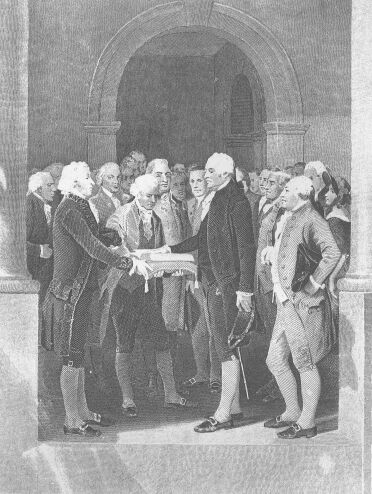
The first ever picture puzzle seemed to puzzle everyone ( or at least Billy since he was the only one to comment). Hopefully the next picture puzzle will get more responses. Anyway picture #1 was showing George Washington's 1st inaugural at Federal Hall in New York City on April 30, 1789. This relates to the Constitution because it was the Constitution that created the office of President.

We know that the Constitutional Convention took place in Philadelphia during the summer of 1787. It was during this critical time that debates concerning state versus national authority took place. It was agreed that a stronger national government was needed to solve the many problems the young United States was facing. The problem was that most of the founders feared that the strengthening of the national government may lead to an American monarchy or a similar form of government that would betray the spirit of 1776.

How could the Founders stregnthen the national government without placing too much power in the hands of one person? The answer was provided by creating a federal system where the national and state powers are clearly defined, thereby saving important authority to the state and local governements. In addition, the national government was divided into three branches headed by three different groups of people. To further spread out the power of the national government there were a series of checks and balances that were written into the Constitution that made it necessary for each branch to work together and oversee the others. This system may not work perfectly, but it certainly was an improvement over what the Articles of Confederation provided.

When the Constitution was finally ratified in June 1788 preparations were made to hold the first Presidential election. Of course, George Washington was elected. When Washington left Mount Vernon on April 16, 1789 to go to New York City to be inaugurated President of the United States he did not know what was in store for him or the nation. The Constitution actually spelled out very little specifics about the responsibilities of the office. Everything Washington did as President would become a precedent that future Presidents would look to for guidance. One thing that the Constitution did spell out was the Oath of Office. When Washington took the Oath in Federal Hall he spoke the same words that have been spoken by every President since 1789: "I do solemnly swear that I will faithfully execute the Office of President of the United States, and will to the best of my ability, preserve, protect and defend the Constitution of the United States" And then after a brief pause Washngton added something the Constitution did not include, but has become part of the oath ever since--"So help me God".